Data & Numbers / File 01
Measured, calculated, or normalized?
A useful launch-monitor report starts by telling you how each number was produced.
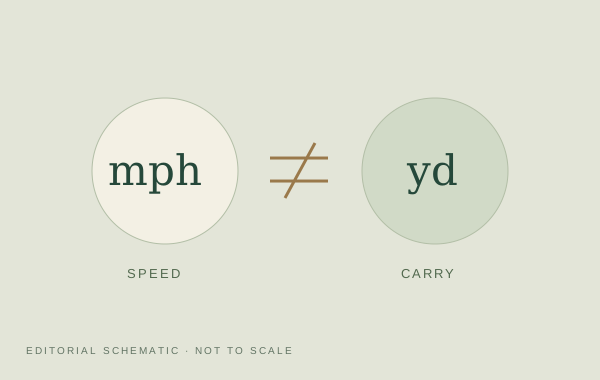
Before comparing two results, ask what was captured, what was calculated, and which conditions the number describes.
A useful launch-monitor report starts by telling you how each number was produced.
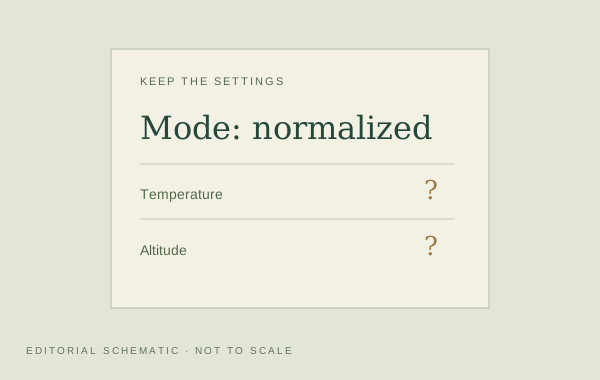
In Foresight’s GC2 documentation, launch conditions feed an algorithm for flight outputs. Trackman’s Normalization offers a separate example: modeled flight under selected conditions.
Those are different questions, not interchangeable labels.
Follow the distinctionsDecode your labels and save a voluntary device-only record. No predicted carry or ideal range.
Open the decoderThree launch numbers deserve three clear labels—not a distance prediction.
Save the conditions with the number, not just the number.
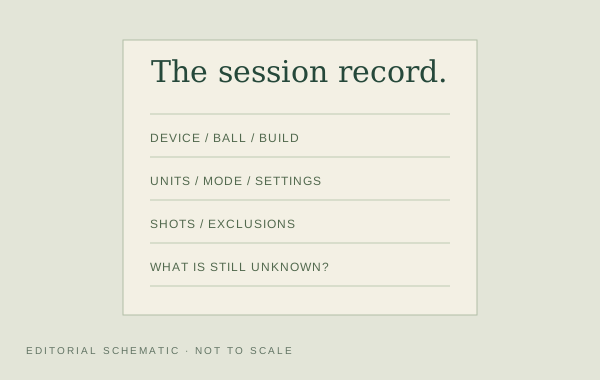
Keep a reproducible session note—not a decontextualized best shot.
Scroll the table horizontally to read every column.
| Parameter | Unit | Meaning | Documented example |
|---|---|---|---|
| Ball speed | mph | Speed of the ball after impact. | Measured launch input in the GC2 guide. |
| Launch angle | ° | Initial vertical launch direction. | Measured launch input in the GC2 guide. |
| Total spin | rpm | Rotation rate of the ball. | Measured launch input in the GC2 guide. |
| Carry distance | yd | Flight distance, excluding bounce and roll. | Calculated flight output in the GC2 guide. |
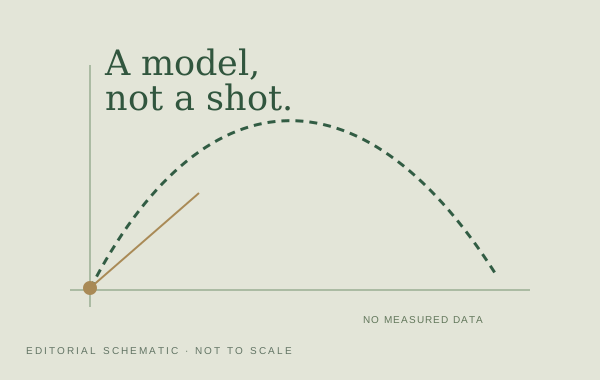
No performance dataset in this edition. We have not collected shots or reproduced tour-average benchmarks. The illustrations are conceptual, not measured launch-monitor charts. There is no implied “ideal” number for your swing.