
Choose a 54° wedge if it fills the gap between your gap wedge and your highest-lofted wedge. Choose a 56° if it spaces those clubs better or gives you the bunker performance you need. A 50° gap wedge and 58° lob wedge point toward 54°; a 52° gap wedge and 60° lob wedge point toward 56°. Your carry numbers get the final vote.
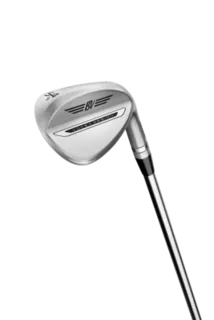
The wrong wedge can give you two ways to hit the same yardage and no comfortable way to hit the one you actually need. That’s why the useful question at the shop isn’t “Is 54 or 56 better?” It’s “What shot is missing from my bag?”
54° vs. 56°: Start with the wedges you already own
Titleist suggests starting with 4–6 degrees between wedges. That’s a fitting starting point, not a required setup or a yardage promise. Check your pitching wedge’s actual loft rather than relying on the “P” stamp. These are examples, not recommendations based on measured distances:
| Your other wedges | Try first | Why |
|---|---|---|
| 46° PW, 50° gap wedge, 58° lob wedge | 54° | Gaps of 4° / 4° / 4°. A 56° leaves a 6° jump from the gap wedge and only 2° to the lob wedge. |
| 46° PW, 52° gap wedge, 60° lob wedge | 56° | Gaps of 6° / 4° / 4°. A 54° puts two wedges just 2° apart and leaves a 6° jump to the 60°. |
| 44° PW, 50° gap wedge, no lob wedge | 56° to start; test a 54° too | A 56° makes two 6° gaps. A 54° makes the bottom gap 4° and may suit a player looking for a stock approach wedge rather than more loft. |
| 44° PW and no gap wedge | Fit the gap wedge first | Jumping straight to 54° or 56° leaves 10° or 12° on paper. Try a wedge between them before assuming you need a different sand wedge. |
How far does a 54° go compared with a 56°?
There’s no reliable yardage to assign to those two numbers. To see how the decision works, imagine your 50° carries 96 yards and your 58° carries 76. If a candidate 54° carries 86 and a candidate 56° carries 81, the 54° leaves a 10-yard gap on either side. The 56° leaves a 15-yard gap above it and just five below. Those numbers are hypothetical, but that’s the kind of decision a fitting should resolve. If your measurements come out differently, follow them.
Bring the clubs on either side of the gap. Hit eight to ten representative shots with each club using the same ball and a swing you’d trust on the course. Record carry, not total distance. Compare median carry as well as the front-to-back spread; keep ordinary misses in the picture, and don’t let your cleanest strike make the decision. Then try the shot that sends you reaching for this wedge most often: a stock approach, a pitch over a bunker or an actual bunker escape.
Is a 54° or 56° better from the sand?
Start with the sand you play. If it’s soft and fluffy and your wedge tends to dig, a higher-bounce option is worth trying. If it’s firm and packed and the sole tends to skip into the ball, test a lower-bounce or differently shaped sole. How steeply you deliver the club and how much you open it matter too. Opening the face adds delivered loft and can present more bounce; see whether you can make clean contact from your typical lie rather than buying loft to solve a sole problem.
You can compare loft without also switching the sole. Titleist’s Vokey SM11 specs list both 54° and 56° in S grind with 10° of bounce (and the same published stock length). Cleveland’s RTZ Black Satin specs likewise list both lofts in MID grind with 10° of bounce. Comparing the same model, grind and shaft is a better first step than comparing two radically different soles. After deciding on loft, test bounce and grind against the lies you actually play.
The Fairway File call: Start with 54° between 50° and 58°, or 56° between 52° and 60°. If the numbers on the range disagree, believe the numbers. If the carry gaps are both playable, put the sole you trust from your own bunkers in the bag.
How we put this together: Manufacturer specs and fitting guidance inform the comparisons; carry examples are illustrations, not test results.
Keep reading: What loft, bounce and grind change on a wedge · Cleveland RTZ 2 Tour Satin 56° grind guide
Related equipment guides
Wedge loft, bounce and grind explained · Cleveland CBZ Tour Satin 56° guide · Compare Cleveland’s 56° sole options